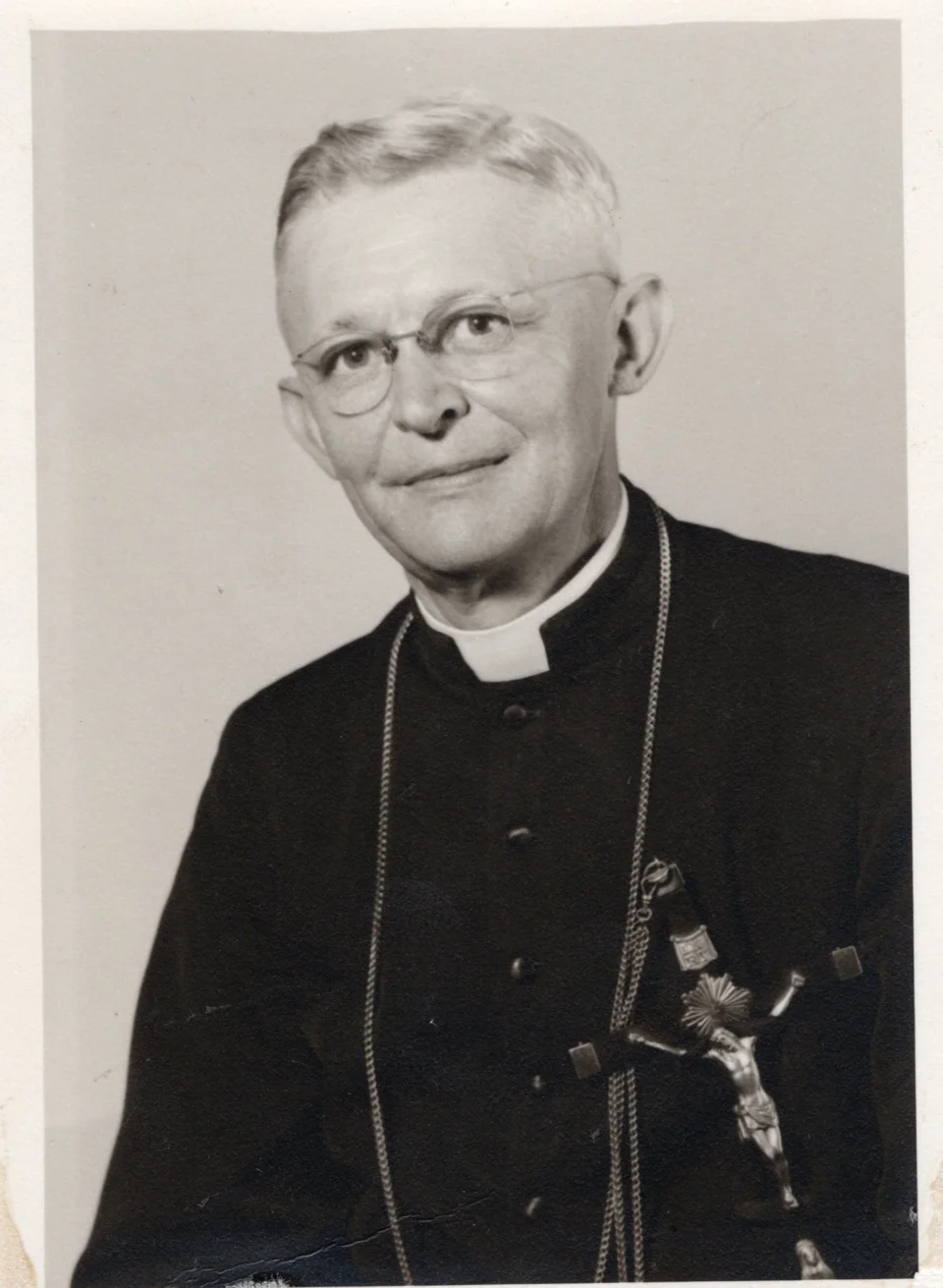
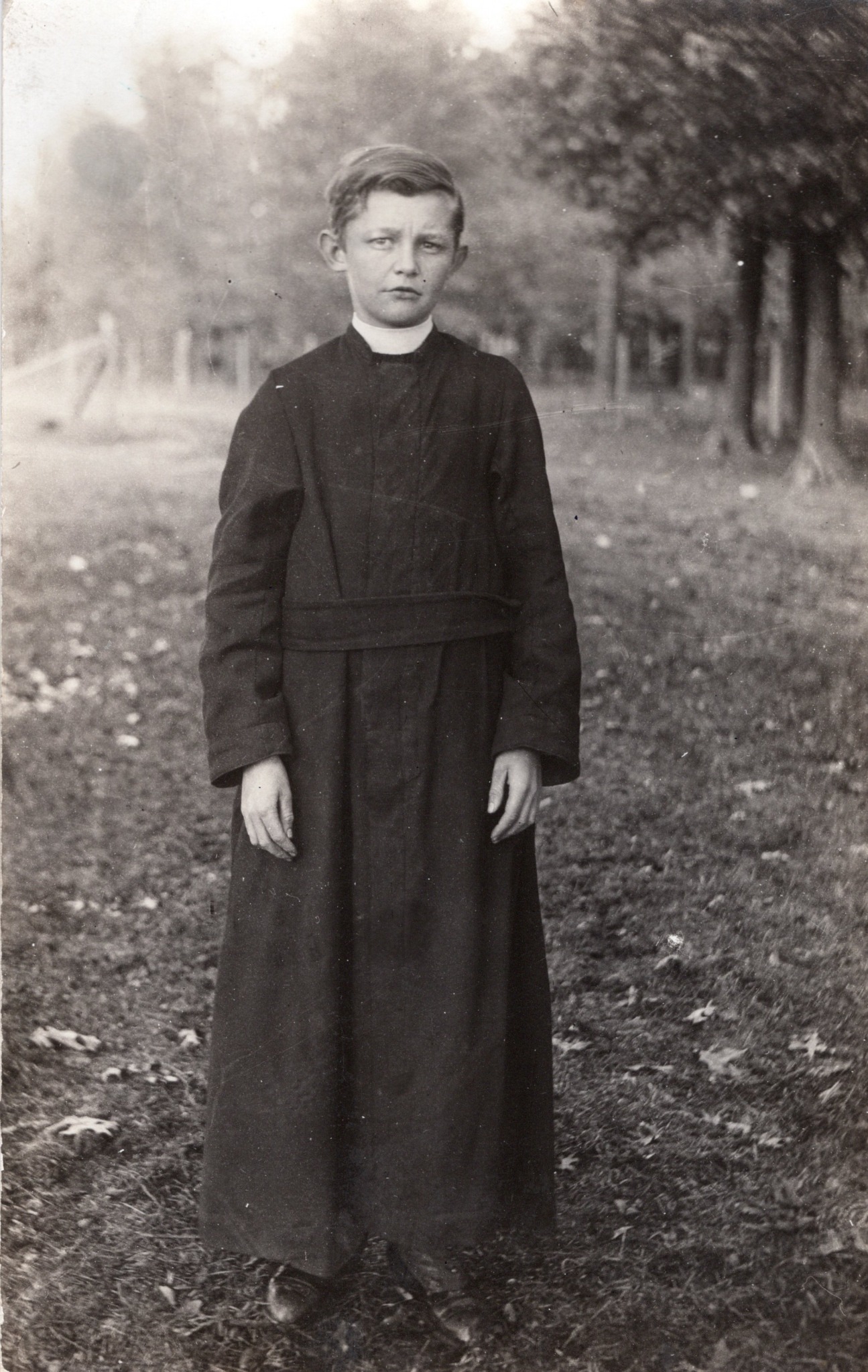
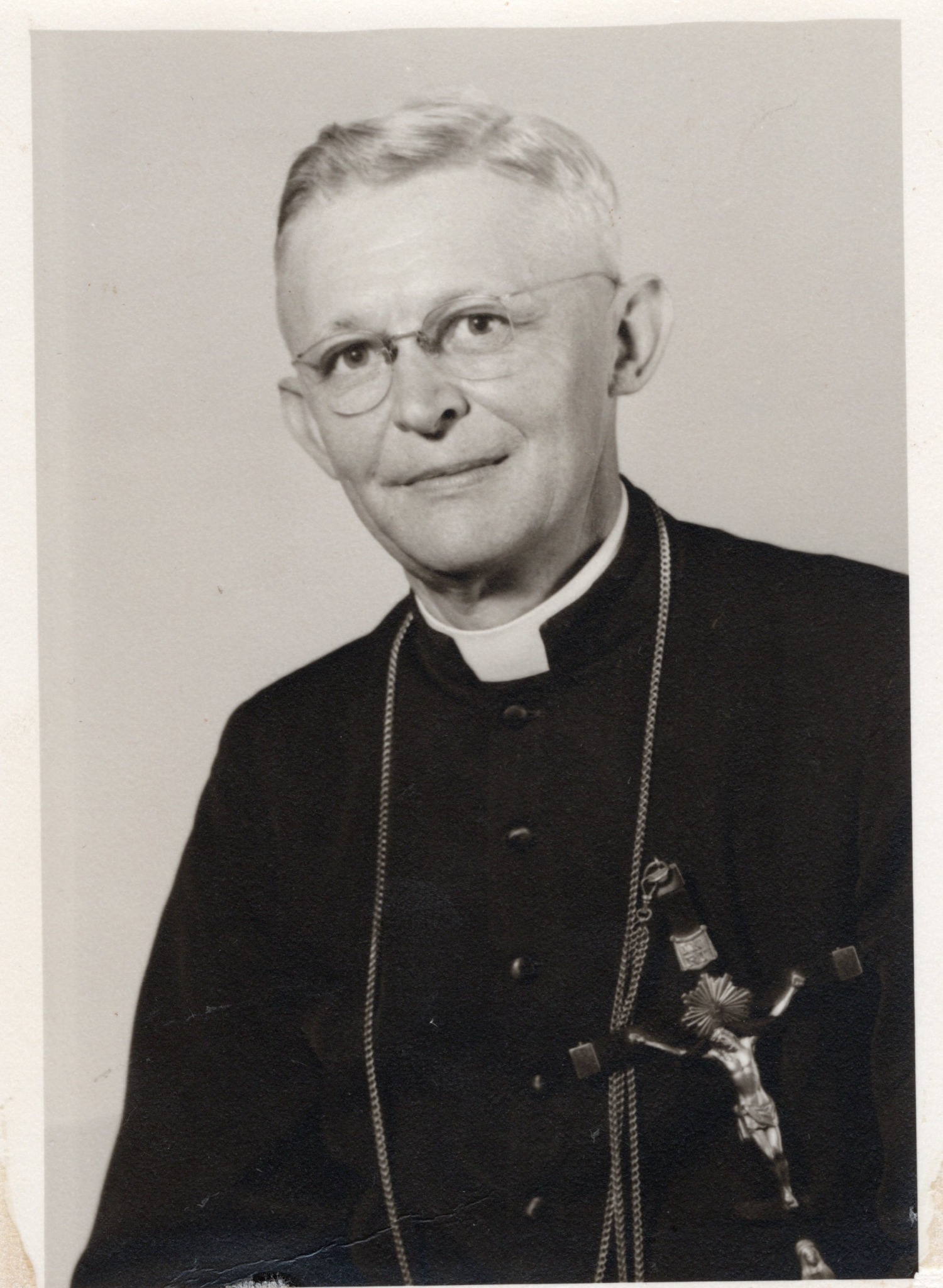
Rev. George J. Niekamp Said His First Mass at Holy Trinity Church Tuesday Morning
Many Visiting Priests, Relatives and Friends Were Present.
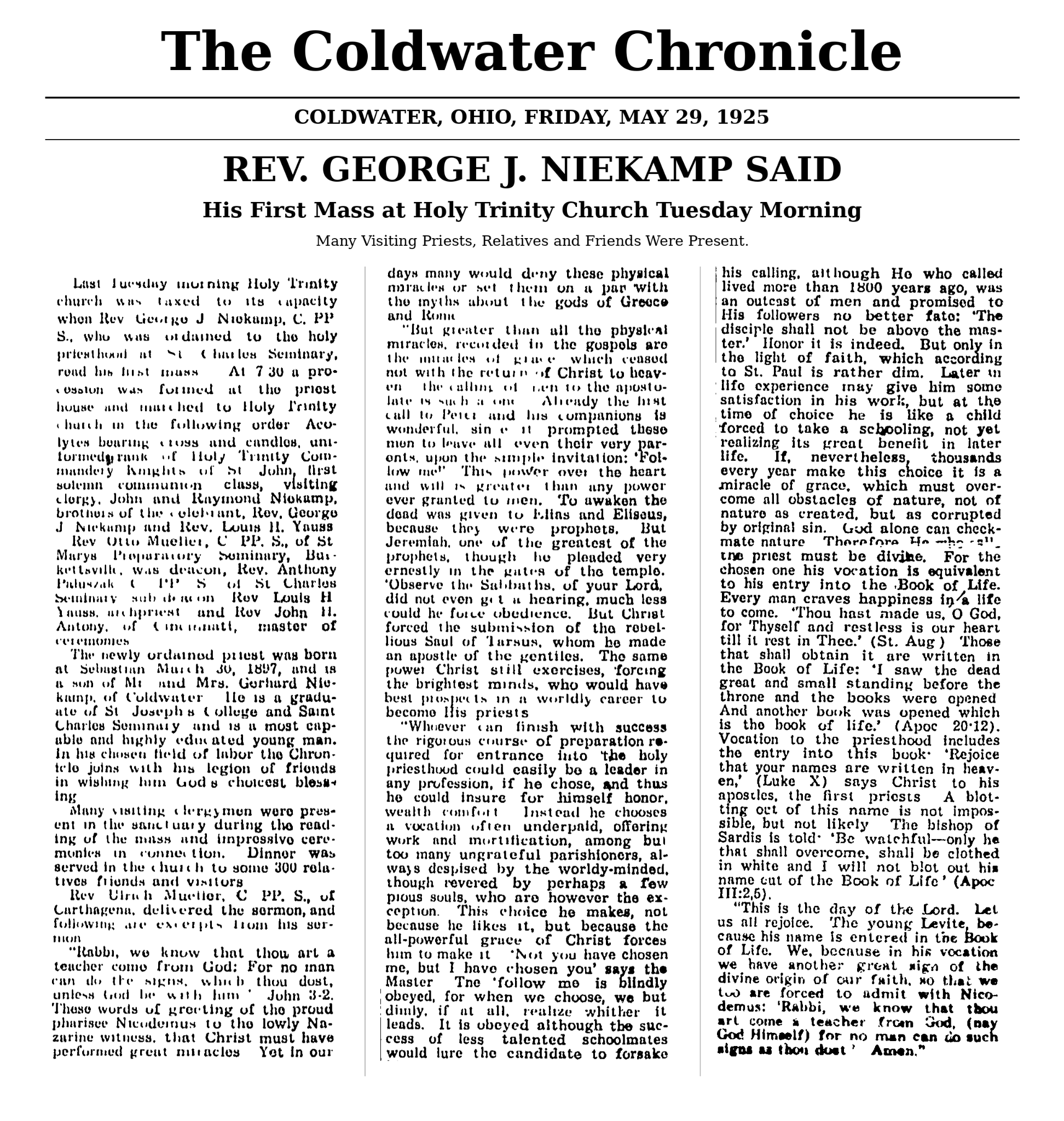
Last Tuesday morning Holy Trinity church was taxed to its capacity when Rev. George J.
Niekamp, C. PP. S., who was ordained to the holy priesthood at St. Charles Seminary,
read his first mass. At 7:30 a procession was formed at the priest house and marched
to Holy Trinity church in the following order: Acolytes bearing cross and candles,
[unclear word] of Holy Trinity Commandery Knights of St. John, first solemn communion
class, visiting clergy, John and Raymond Niekamp, brothers of the celebrant, Rev.
George J. Niekamp and Rev. Louis H. Yauss.
Rev. Otto Mueller, C. PP. S., of St. Marys Preparatory Seminary, Burkettsville,
was deacon, Rev. Anthony Pelczak C. PP. S. of St. Charles Seminary sub-deacon,
Rev. Louis H. Yauss, archpriest and Rev. John H. Antony, of Cincinnati, master of
ceremonies.
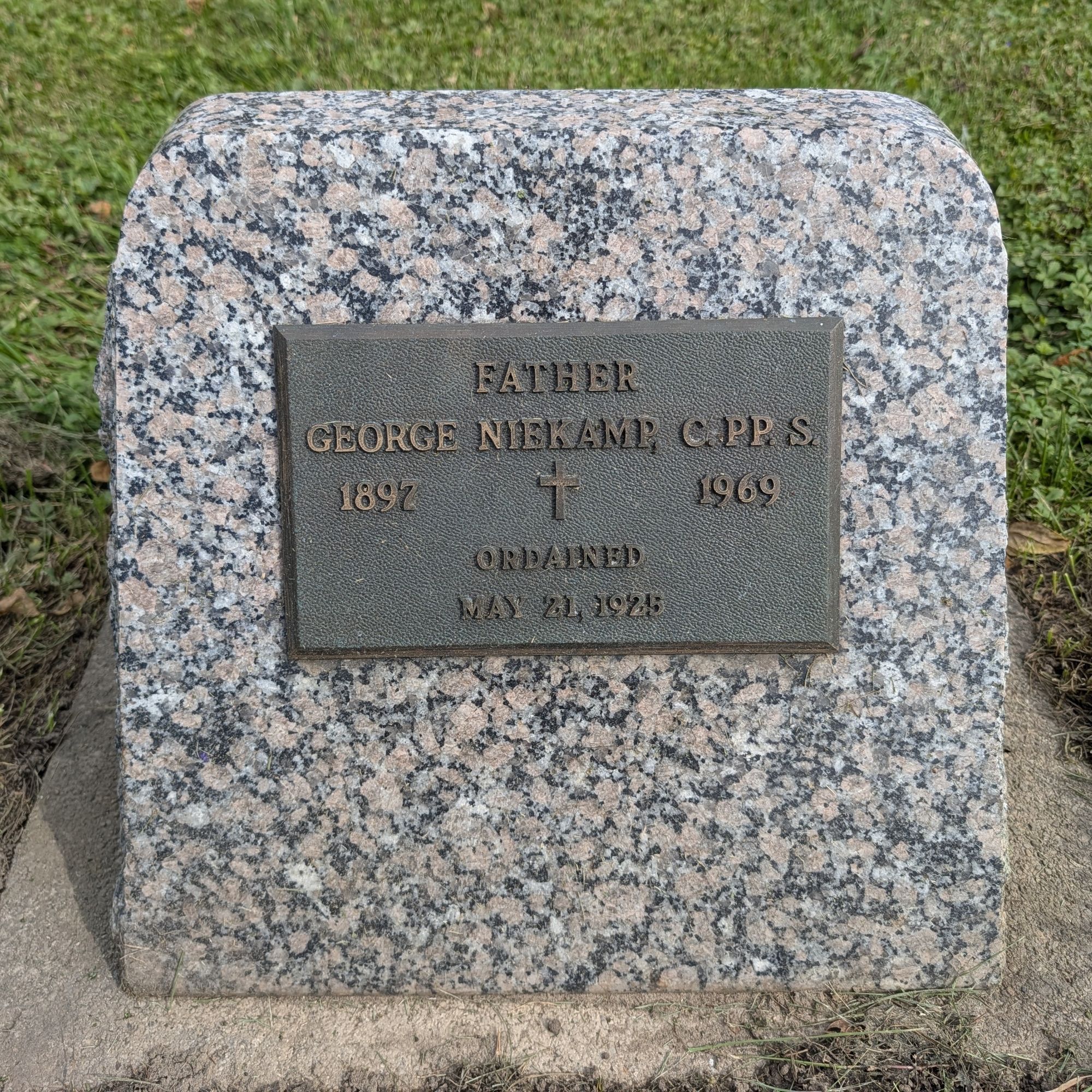
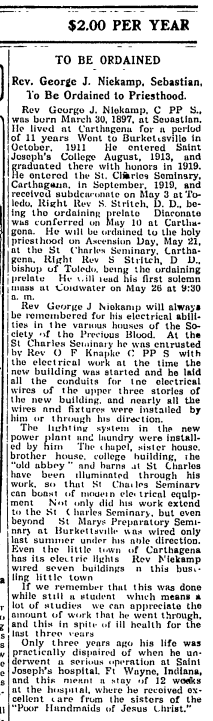
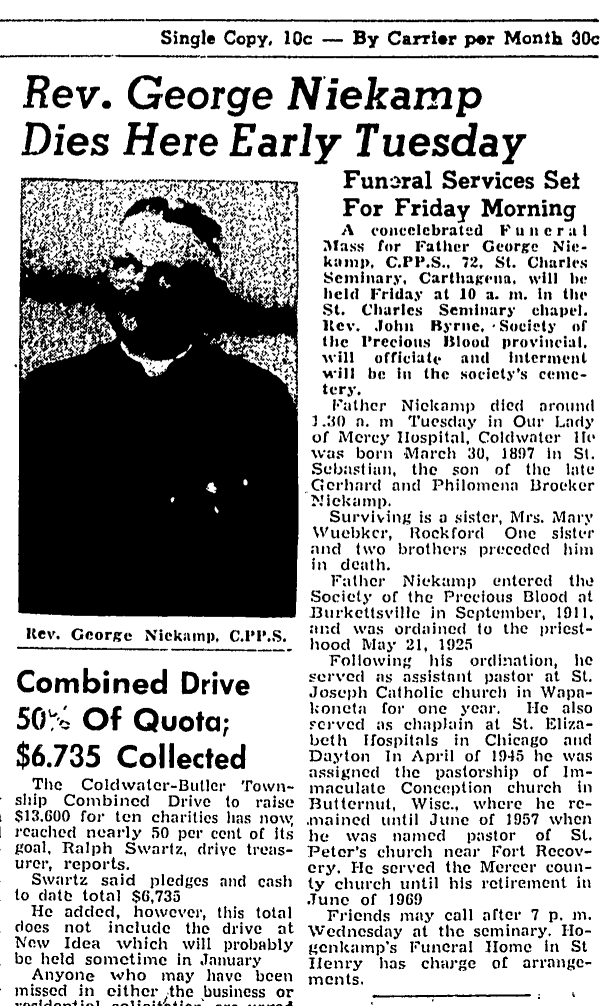
The newly ordained priest was born at Sebastian March 30, 1897, and is a son of
Mr. and Mrs. Gerhard Niekamp, of Coldwater. He is a graduate of St. Joseph’s
College and Saint Charles Seminary and is a most capable and highly educated young
man. In his chosen field of labor the Chronicle joins with his legion of friends
in wishing him God’s choicest blessing.
Many visiting clergymen were present in the sanctuary during the reading of the
mass and impressive ceremonies in connection. Dinner was served in the church to
some 300 relatives friends and visitors.
Read more
Rev. Ulrich Mueller, C. PP. S., of Carthagena, delivered the sermon, and following
are excerpts from his sermon:
“Rabbi, we know that thou art a teacher come from God: For no man can do the
signs, which thou dost, unless God be with him.” John 3:2. These words of greeting
of the proud pharisee Nicodemus to the lowly Nazarine witness, that Christ must
have performed great miracles. Yet in our days many would deny these physical
miracles or set them on a par with the myths about the gods of Greece and Rome.
“But greater than all the physical miracles, recorded in the gospels are the
miracles of grace, which ceased not with the return of Christ to heaven. The
calling of men to the apostolate is such a one. Already the first call to Peter
and his companions is wonderful, since it prompted these men to leave all even
their very parents, upon the simple invitation: ‘Follow me!’ This power over the
heart and will is greater than any power ever granted to men. To awaken the dead
was given to Elias and Eliseus, because they were prophets. But Jeremiah, one of
the greatest of the prophets, though he pleaded very earnestly in the gates of the
temple, ‘Observe the Sabbath, of your Lord,’ did not even get a hearing, much less
could he force obedience. But Christ forced the submission of the rebellious Saul
of Tarsus, whom he made an apostle of the gentiles. The same power Christ still
exercises, forcing the brightest minds, who would have best prospects in a worldly
career to become His priests.
“Whoever can finish with success the rigorous course of preparation required for
entrance into the holy priesthood could easily be a leader in any profession, if
he chose, and thus he could insure for himself honor, wealth comfort. Instead he
chooses a vocation often underpaid, offering work and mortification, among but too
many ungrateful parishioners, always despised by the worldly-minded, though
revered by perhaps a few pious souls, who are however the exception. This choice
he makes, not because he likes it, but because the all-powerful grace of Christ
forces him to make it. ‘Not you have chosen me, but I have chosen you’ says the
Master. The ‘follow me’ is blindly obeyed, for when we choose, we but dimly, if at
all, realize whither it leads. It is obeyed although the success of less talented
schoolmates would lure the candidate to forsake his calling, although He who
called lived more than 1800 years ago, was an outcast of men and promised to His
followers no better fate: ‘The disciple shall not be above the master.’ Honor it
is indeed. But only in the light of faith, which according to St. Paul is rather
dim. Later in life experience may give him some satisfaction in his work, but at
the time of choice he is like a child forced to take a schooling, not yet
realizing its great benefit in later life. If, nevertheless, thousands every year
make this choice it is a miracle of grace, which must overcome all obstacles of
nature, not of nature as created, but as corrupted by original sin. God alone can
checkmate nature. Therefore He who calls the priest must be divine. For the chosen
one his vocation is equivalent to his entry into the Book of Life. Every man
craves happiness in a life to come. ‘Thou hast made us, O God, for Thyself and
restless is our heart till it rest in Thee.’ (St. Aug.) Those that shall obtain it
are written in the Book of Life: ‘I saw the dead great and small standing before
the throne and the books were opened. And another book was opened which is the
book of life.’ (Apoc. 20:12). Vocation to the priesthood includes the entry into
this book. ‘Rejoice that your names are written in heaven,’ (Luke X) says Christ
to his apostles, the first priests. A blotting out of this name is not impossible,
but not likely. The bishop of Sardis is told: ‘Be watchful—only he that shall
overcome, shall be clothed in white and I will not blot out his name out of the
Book of Life’ (Apoc. III:2,5).
“This is the day of the Lord. Let us all rejoice. The young Levite, because his
name is entered in the Book of Life. We, because in his vocation we have another
great sign of the divine origin of our faith, so that we too are forced to admit
with Nicodemus: ‘Rabbi, we know that thou art come a teacher from God, (nay God
Himself) for no man can do such signs as thou dost.’ Amen.”
Transcription note: One word describing the procession is unclear in the supplied
clipping. A damaged phrase in the sermon is read as “He who calls”; consult the
image for the original.