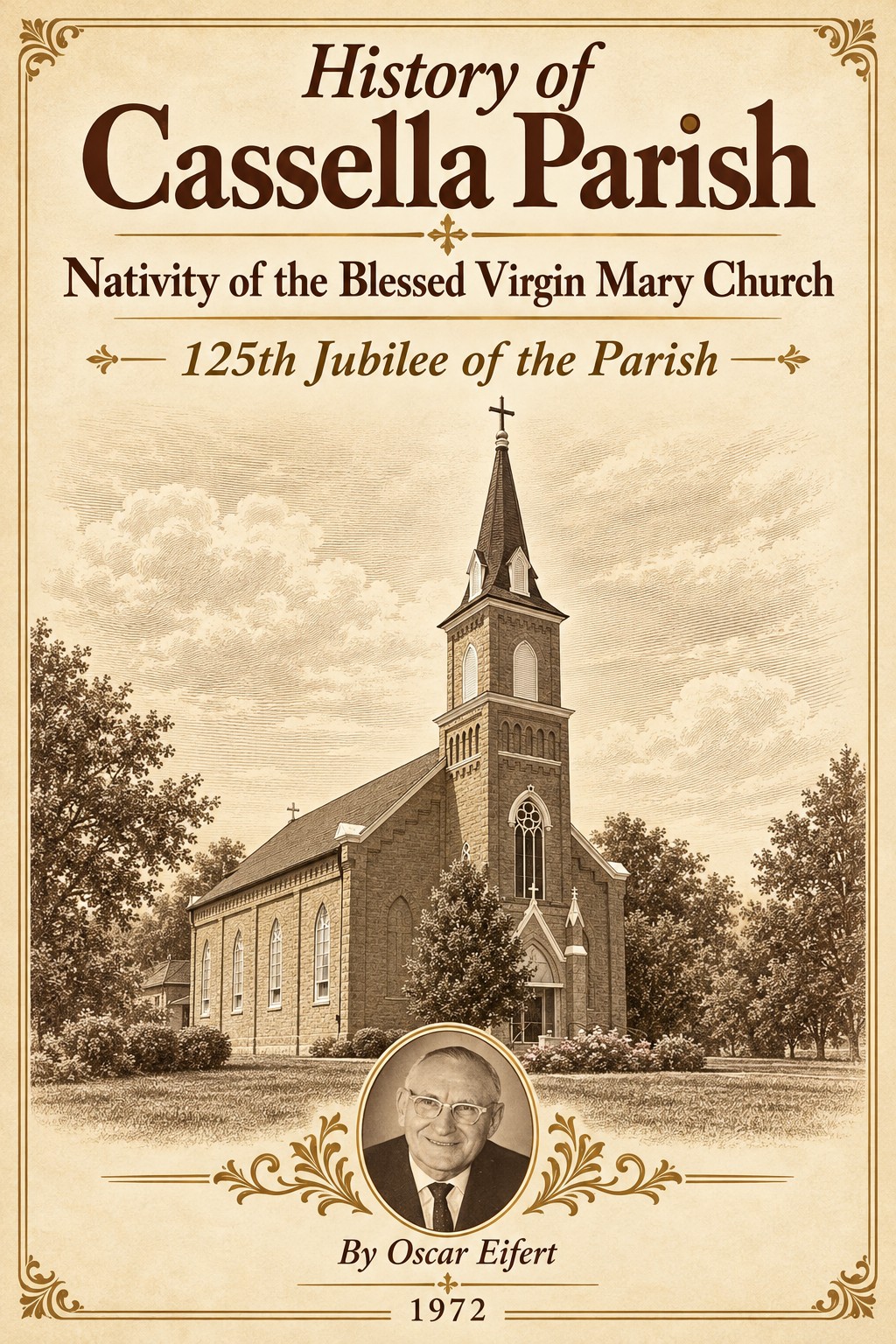
Looking back one hundred and twenty-five years, we can imagine Mercer County as a wilderness broken by an occasional trail that wound through this practically uncivilized land. At this time, however, some settlements were being made, following the footsteps of some of the frontiersmen. The population of entire Mercer County at that time was 1100. A speedy settlement of the territory followed with the result that 10 years later the present Marion township had as many settlers as the entire county in the previous census.
In the year 1839 the parishes of St. Rose, St. Henry and St. Victoria were founded. Within 10 years, however, the former parish was so extensive that it was only with difficulty that the needs of all the faithful could be satisfied. Consequently, two parishes taken from St. Rose, namely Cassella in 1847 and St. Sebastian in 1851. It is with former that we are now concerned.
Some of the earliest German immigrants who settled Cassella were the Stelzer, Cron, Hierholzer, Schunck and Mueller families. Of these families, the Stelzer, Cron, and Hierholzer families are still found in this vicinity and are direct descendants of those families of hundred and twenty-five years ago. The early immigrants, as well as the other neighboring people, were all loyal earnest hard working Catholics.
Immediately upon their separation from St. Rose parish, they built a small frame church which was located directly west of the present site across the road, or where Frank Feltz Jr. now has a garden. There a frame church stood for many years. It was dedicated under the title of the Nativity of the Blessed Virgin Mary.
Owing to the lack of complete records, we must imagine that it was only a mission church at first. During these 10 years many priests attended to the needs of the parish - usually traveling missionaries - some remained three or four months, others only two or three weeks. Most of them, since Cassella had no parsonage at that time, resided at the Maria Stein convent or after 1849 at Gruenwald convent.
The first resident pastor seems to have been Rev. Andrew Herbstritt, C.PP.S., (1851-1857). His successor, Rev. Henry Drees, who had charge for a very short time, was in turn followed by Rev. Peter Habertheur. It was during the latter’s stay that the new church was built in 1858.
The parish, having been organized and formed in 1847, 125 years ago, show in the first available records that the first child baptized in the newly erected church was Elizabeth Schmidt, daughter of Paul Schmidt and Catherine Ranly. The first priest was Father Mathias Kruesch, C.PP.S. Other priests who followed in 1848 were missionaries - Father Anton Capever, Father John Wittmer, and Father Broener.
The first marriage at Cassella, performed by Father Kruesch, was Jerobaum Blattauer and Anna Marie Troeseler.
Familiar names in baptismal records show children of Valentine Link, Michael Blathau, Anton Mueller, Jacob Schunck and Henry Schurman during the first two years of the existence of the new parish.
Father Broener was followed by Fathers Gruther, Andreas Kunkier, Alois Schelbert and Albrecht. Then came Father Andrew Herbstritt, who was in charge of the parish for six years. He was followed by Father Henry Drees and Father Peter Habetheur.
The mission church was too small to take care of the increasing population, so a new church had to be built. During Father Peter Habertheur's pastorate, a new larger church was built in 1858. A rather interesting controversy is recorded in regard to this matter. The people of Cranberry Prairie had separated themselves from St. Henry and desired to form one parish with Cassella. Accordingly, they proposed to build a church on the August Stelzer farm due east of St Henry situated along the diagonal road converging with the present highway 127. The church would have been midway between the present parishes of Cassella and Cranberry along the Stelzer Road.
Those living east of Cassella, however, objected to the plan since it would mean a walk of many miles to church and the added hardship would mean less attendance. The matter was decided by a vote, and in this democratic manner the people determined to build a church to the right of the old mission church. So a new building was erected only a few rods from the old structure. Cranberry then organized its own parish under the patronage of St. Francis.
Father Peter Habertheur was the first pastor of Cassella’s newly built brink church. In January 1861, Father Bernard Austermann occupied the pastorate, to be succeeded by Father Mathias Freusch a few months later.
About this time the town of Cassella was laid out, including among its notable features a post office.
History records show that subsequent pastors were Fathers Peter Wilhelm (May-July 1862), Henry Drees (1862-1864), Anton Guggenberger (1864-1866). Others followed from 1866 to 1870. For two months Father Anton Kramer ministered to the people. He was followed by Father Rochus Schulz until June when Father Jacob Marte administered to the wants of the faithful in Cassella. In 1872 Father Francis Nigsch performed the duties of pastor. In 1874 he in turn, was succeeded by Father Engelbert Ruf, under whose supervision a $100 organ was installed. Then came Father Sebastian Ganther (1875-1885). It was during his pastorate that many improvements were made in church. Beautiful paintings and woodwork were added. It was during his pastorate that Father Leo Boehmer was ordained as the first priest of Cassella. Father Ganther spared no effort to make this a memorable event and it was an honor to have a priest read his first Mass in the parish church. From 1886 until June 1888, Father Theobald Schoch assumed charge of the parish, when Father Augustine Seifert was designated pastor protem. His appointment was made on the same day on which the Cassella church was destroyed by fire.
During Father Schock's last few days of his pastorate that the "demon fire" visited the little church. When the dried shrubs and plants that remained about the building after the Corpus Christi festivities, were set on fire, unfortunately some stray sparks set the shingles on the roof ablaze and in a short time woodwork, pictures and altars were destroyed. The story has it that everything in the interior burned, except, miraculously, a hand painted picture by Father Paulinus Trost was unharmed; while all that surrounded it was a mass of charred wood. Only the four brink walls remained — a ghastly ruin.
This painting was placed again in the reconstructed church. Father Augustine Seifert at once began to take up subscriptions in his new parish and furthermore canvassed the entire parishes of St. Rose and St. John as well as parts of others to solicit funds. The work of restoration progressed rapidly so that when Father Martin Dentinger arrived in 1888, he found the little edifice nearing completion. The exterior was complete with the exception of the spire. Through the efforts of Father Martin Dentinger, the interior of the church was frescoed and furnished with new altars and windows. A new tower had to be erected and this is the same tower that we see today. The tower is over one hundred feet high and on top of it was placed a gold cross and ball. Father Dentinger was halted in the renovation of the church by the appointment of Father Charles Mayer, who followed him and continued his good work. Father Charles Mayer was succeeded by Father Henry Drees, who for a few years had charge of Cassella as well as St. Rose.
A notable event happened in 1893 when Father Mark Hamburger was ordained as the second priest of this parish, June 21, 1393. Father Drees was then pastor of Cassella and the event was solemnized in a fitting manner. Father Mark Hamburger later was pastor of St. Mark's Church, Cincinnati for 27 years. He died at St. Charles Seminary in 1943.
Many improvements were made in church, including the installation of beautiful art windows which are inspiring to see and by these windows are told the mysteries of the rosary. Then came an important event - the installation of a new organ - pumped by hand until it was electrified many years later.
To Father Charles Romer, the next pastor, 1902, goes the credit of erecting the beautiful, spacious parsonage. This large parsonage added much beauty to the brick church since it was of the same type of construction. The parsonage still stands in practically the same surroundings as at that time. Father Romer died only 10 years after leaving the Cassella parish in his assignment at Lorain, Ohio on his 25th anniversary. It was during his pastorate that Father Eugene Omlor entered the priesthood and was ordained in 1921. He said his first Mass in Dayton since his parents had moved there.
Records also show that Father Clement Boeke was ordained as the third priest of this parish while Father Heffner was pastor. Some of the parishioners of Cassella can faintly remember Father Heffner. Upon his shoulders fell the task of both enlarging and beautifying the church.
He was also obliged to repair the roof, ceiling and windows after a fierce storm had wrought havoc. The repairs were of considerable extent and much labor was donated in repairing the church. Then too, Father Julius Heffner realized the value of having a basement placed beneath a part of the church and in the basement an efficient heating system was installed.
During the digging of the basement of the church, the church was seriously damaged. It was a year and half after Father Heffner had started the renovation, when it was decided to place a basement below the church and erect a sacristy above it. While digging a basement, too much ground was removed from the foundation of the church and suddenly one morning the entire back part of the church caved in. During this great loss to the parish, the beautiful painted Madonna picture done by Father Trost, was destroyed and broken into many pieces.
Several people of the parish still remember the year 1914, for this meant more work and more money for reconstruction.
It did not take very long however to build a larger basement and enlarge the church; then on its safer foundation was placed a sacristy.
Then a new heating plant was installed by the late John Kramer of Maria Stein. This heating plant, a vapor system, is still being used today. However, it has been replaced by an oil installation in the old furnace which works automatically.
It was also during Father Julius Heffner’s pastorate that the church was stucco-coated over the scarred brick church enhancing its beauty considerably. This coating is still admired by many and its unique and pleasant effect has been universally praised. This work was done during 1915. Father Heffner administered to the faithful of this parish until 1922. During his pastorate many students left for the priesthood, some of them were successful in persevering and others not so fortunate. Yes, indeed Father Heffner left behind him a lasting monument of zeal and love for his flock.
In May 1922 Father Ulrich Mueller was appointed pastor, but remained only during the summer months, and in September Father Francis Nigsch became the new pastor. He continued where Father Heffner left off, and more improvements were made. It was in this renovated church that Father George Grevenkamp offered his first Mass, making the fourth priestly vocation from this parish.
It is a strange coincidence that Father Francis Nigsch, who began his priestly career in this parish, should likewise end it here. Yet such was his lot and he seemed to have relished his work in the parish that had enjoyed the first fruits of his priestly labors, the years of 1872-1874. Pious, yet jovial, he won the esteem of the whole parish; his work was one of kindness and of love, which was broken off only by his failing health. Because of this he was removed to St. Charles seminary in October 1928, where he died a month later.
It was during the illness of Father Nigsch, that Most Rev. Gregory Boeckman became a priest. Although a Cassella boy, he offered his first Mass in Coldwater. He has always been claimed as a priest of this parish, the fifth of this parish.
On October 20, 1928, Father Vincent Muinch admirably took charge of the parish. Father Muinch will long be remembered because of his nature, his tireless energy and love for beauty. During his pastorate the church was artistically frescoed and he obtained a truly beautiful life-like set of "Stations of the Cross" which were imported from Italy. After an extremely long delay, these Stations finally arrived during the summer of 1930. He also planted a most beautiful arrangement of shrubbery around the church and parsonage. While he was pastor, he also installed a new floor in the sanctuary and made other improvements in the church.
A sad event occurred in this parish when on April 24, 1929 Julius Frenzer, another Cassella student of theology at Collegeville, Indiana was preparing for the priesthood, died at the college infirmary and was buried in the church cemetery a few days later.
A most happy event occurred when Father Urban Siegrist (a science professor at St. Joseph College at present) was ordained to the priesthood on May 10, 1934 as the sixth priest-son from Cassella. He offered his first Mass in the Cassella parish a few days later, and Father Muinch spared no efforts to make this event a memorable one. It was indeed a solemn occasion. Today, Father Siegrist often visits the church and has many interesting events to recount.
Two weeks later the late Father Leo Boeke was ordained a priest in Cincinnati as the seventh priest-son from this parish. He offered his first Mass the following Sunday at Cassella. He was the first one of the Boeke boys to be ordained — three others were preparing for ordination to the priesthood, at that time. Clement Boeke died as a student at College in 1932.
Father Muinch left our parish to go to St. Peter in the year 1935 and Father Liberat Schupp was his successor. Father Schupp arrived in Jan. 1935 and remained as pastor until September 1, 1939. He was loved by all the members of the parish and his kind manners were appreciated by all.
In September 1939, Father Ivo Weis became pastor of our parish and did splendid work. Father Weis had the church cleaned and redecorated. He also had the porch of the parsonage repaired. It was during his pastorate that we had several first Masses.
Father Victor J. Ranly was ordained at Carthagena, Ohio on Sept. 8, 1940 and offered his first Mass on Sunday, September 15, 1940. Father Victor Ranly is now pastor of the Precious Blood Parish at Fort Wayne, Indiana. Father Ivo Weis had the church beautifully decorated and spared no efforts in making this a solemn and memorable occasion. Father Ranly was the eighth priest from Cassella to enter the vocation of the priesthood.
Also during Father Weis's pastorate, the second Boeke, Father Aloysius Boeke, was ordained on June 28, 1941 and offered his first Mass in our church on July 6, 1941. Father Aloysius Boeke is now pastor of St. Mary’s Church of Springfield, Ohio.
The next year, Father Victor Broering offered his first Mass on May 31, 1942. He has recently retired in Sierra Vista, Arizona after spending most of his priestly life as an army chaplain both in this country and abroad.
The following year Father Ivo Weis left for Sharpsburg and Father R.P.Stolz came in September 1943. Father Stolz was in failing health, but did remarkable work even though he was seriously sick. Father Stolz died while on duty during his short stay. Father Anselm Boeke offered his first Mass on Dec. 18, 1943. He was the third one of the Boeke family to become a priest. He was the eleventh priest to the credit of our parish. Father Anselm Boeke is now pastor of Holy Rosary Church at St. Mary's, Ohio.
Father Stolz was succeeded by Father Benno Holler in September 1944.
It was during his pastorate that we observed the centennial of our parish on August 3, 1947 with pontifical high Mass and a church picnic. However, he suddenly became ill and after three months in St. Elizabeth Hospital in Dayton, he died at the age of 71. He laid in state in our church and was buried at St. Charles Seminary a few days later.
In September of 1950, Father Edward Vonderhaar arrived from Park Falls, Wisconsin to become our pastor. It was during his pastorate that Father Ernest Ranly (at present a professor at St. Joseph College, Rensselaer, Ind.) was ordained on June 2, 1956 and offered his first Mass on June 3, 1956 in our local church. He was the twelfth priest to be ordained from our parish. Father Donald Ranly was ordained a priest on June 9, 1962 and offered his first Mass in our parish church on Sunday June 10, 1962. He was the thirteenth son of our parish to be ordained a priest of Christ, and the third of the Ranly family to become a priest. This joyful event was followed by a sad event, Father Leo Boeke died at the age of 56 while pastor of St. Thomas More church at Withamsville, Ohio. Burial was in our Cassella Cemetery.
On Sunday, May 23, 1965 Father E. Vonderhaar’s 40th anniversary was observed in our parish. During his pastorate a new roof was put on our church, a $3600 Kimball organ was purchased for the church and the parish hall was obtained from the C.K. of A. for our C.C.D. classes and parish events. Father E. Vonderhaar was loved by everyone during his long stay and he was exceptionally kind and very active in his 19⅔ years in our parish. He retired to St. Charles Seminary on April 28, 1970. A farewell reception was held the previous Sunday at the C. K. of A. hall and Father received many fine gifts for his retirement.
On April 29, 1970 Father Francis J. Decker became our pastor. He came here from St. Patrick, Glynnwood. He made several improvements in our parish including the repainting of the inside of our church and the steeple. He had many other plans for the improvement of the church and rectory, but his life was cut short when he became ill and after several months of illness, he died, at the St. Charles Seminary infirmary on February 12, 1972. He was brought to our church to lie in state on Monday, and on Tuesday morning a Mass of the Resurrection was offered in our parish by Archbishop Leibold with about twenty priests concelebrating the Mass. He was buried at St. Charles Seminary on Ash Wednesday.
On June 12, 1972, Father Vincent Parr former pastor of St. John the Baptist in Maria Stein, became our pastor. He is planning this 125th anniversary and is making tireless efforts to make this a success. We wish him many happy years in our parish and hope his life will be a pleasant one.
A note should be added regarding the priest-sons of the parish. Father Werner Hemmelgarn, C.PP.S. at present appointed to St. Boniface Church, Grenora, North Dakota, spent his childhood here but did not offer his first Mass here. He still considers Cassella as his home-parish. Fathers U. Siegrist and Ernest Ranly are holders of Doctorate titles. Fathers Leo Boeke and Victor Broering served in the armed services of our country. Fathers Clement Boeke and Gregory Boeckmen were both honored with the title of Monsignor.
Finally, it may be said that God has blessed and rewarded this parish with many religious vocations, 13 priests and several sisters. The list of sisters includes: Sister M. Clementia, C.PP.C. (Ridpath), Sister M. Euthalia, C.PP.S. (Boeke), Sister Mary Urban (Siegrist), Sister M. Theodosius (Boeke), Sister Therese Joseph (Ranly), S.F.P., Sister Dorothy Feltz and Sister Grace Miriam (Pleiman), S.F.P.